Ender Links
The ra_ender module moves things between two places that are nowhere near each
other. Three vaults link a pair of endpoints by channel — items, fluids,
power — and a Teleport Anchor moves the player.
- Namespace:
ra_ender - Give all:
/function ra_ender:items/give_all - Anchor help:
/function ra_ender:tools/anchor/help - Runtime architecture: How It Works
Vaults
| Block | Physical block | Carries | Recipe |
|---|---|---|---|
| Ender Item Vault | minecraft:barrel |
Item stacks | 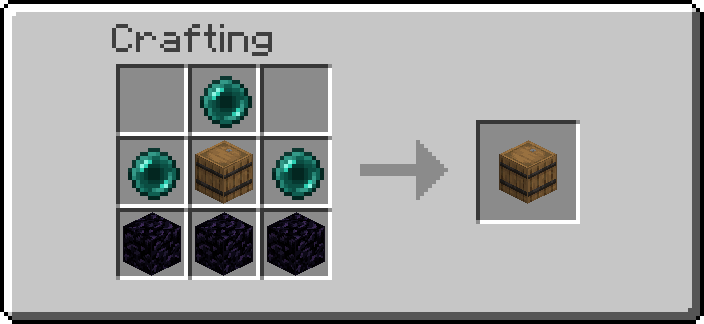 |
| Ender Fluid Vault | minecraft:purpur_block |
Liquid and gas | 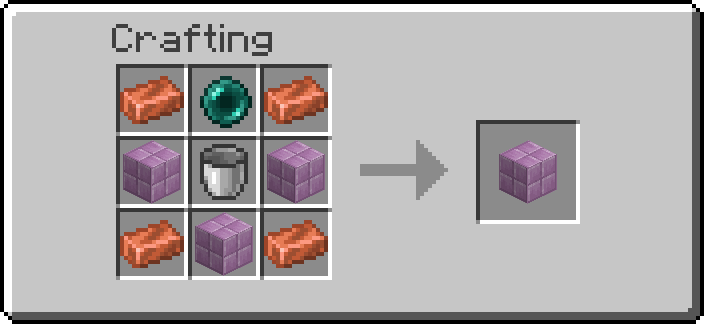 |
| Ender Power Vault | minecraft:purpur_pillar |
EU | 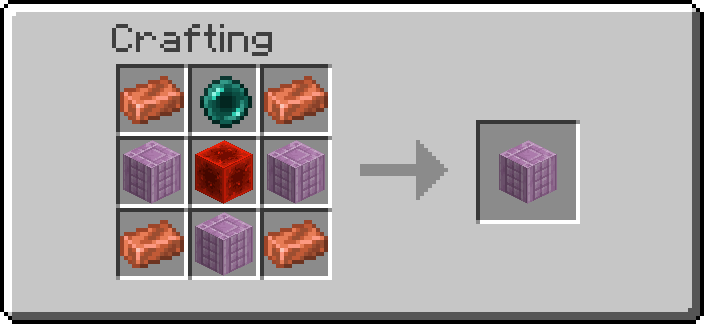 |
Every vault has two properties that matter:
| Property | Meaning |
|---|---|
channel |
A string. Two vaults with the same channel are linked. Default "default" |
mode |
link (default), or send / receive for a one-way pipe |
Set the channel with the Data Handler; cycle the mode with shift + right-click of the Wrench. A channel is a pair in practice: a vault deals with the nearest eligible vault on its channel, so several on one channel means the closest wins.
Why there is no true mirror
The obvious ask — both barrels holding the same items, both usable — cannot be made safe. Mirroring one stack into two barrels gives it two extraction points: two players, or two hoppers, pulling in the same tick each walk away with a copy, and the duplication has already happened before any function runs. Container clicks are not interceptable from a data pack. So there is exactly one real copy of everything in a channel, always, and the modes differ in how it gets to where you want it.
link — two-way, and why each medium does it differently
link is the automation mode: put something in either end, take it out of the
other, no player needed. The naive version of that shuffles forever — A hands its
only stack to B, B now has more than A and hands it straight back — so each medium
gets the rule that suits it.
Items follow the outside world. Each vault remembers how many stacks it left
behind (data.data.last_used) and compares that with what is there now:
| Since last cycle | What happens |
|---|---|
| More stacks — something was inserted | Push one stack to the partner |
| Fewer stacks — something was taken out | Pull one stack back from the partner |
| Unchanged | Nothing. A quiet pair costs nothing per tick |
A delivery updates the receiver's mark immediately, so an arriving stack is never mistaken for an insert and bounced back.
It counts stacks, not items
The mark is the number of stacks in the barrel, so taking part of a stack — 32 out of 64 — does not read as an extraction and does not pull a refill. Take a whole stack. Pull is not a second copy of the move
logic: the asking vault makes itself the only eligible receiver for one command and runs the partner's push.
Fluid and EU find their level, since neither is made of discrete stacks. Only the fuller side pushes, and it pushes half the gap, so the two converge instead of trading the same charge back and forth. A dead zone — 20 units of fluid, 4 EU — stops the last few units oscillating.
One-way send / receive is still there for automation that wants a definite
direction: a send vault drains itself into the channel no matter what the far end
is doing.
Item Vault
A real barrel, so hoppers, Item Pipes, Boxers and your own hands all work on it with no special case. Every 4 ticks — hopper rate — a vault that owes a move sends one whole stack into the first free slot of its partner.
The move is /item replace … from block … followed by clearing the source slot,
via ra_lib:inventory/move_slot. The destination slot is checked empty first,
because item replace overwrites whatever is in the way, and an overwrite would
destroy items. A full partner means nothing moves at all.
Fluid Vault
An ordinary fluid-network node with a 1000 buffer, so pipes, pumps, tanks and
valves treat it like a tank. Every 10 ticks it moves fluid: up to transfer_rate
in one-way mode, or half the gap between the two networks in link mode.
Order matters: take, then offer, then hand back the remainder. A receiving network that is full, or that holds a different medium, accepts less than was offered, and whatever comes back is returned to the network it came from. The fluid is in exactly one network at every point.
Power Vault
Tagged as an electric node with a 400 EU buffer, so wires, generators and
consumers connect to it the way they connect to a switch. Every 5 ticks it moves
EU: up to transfer_rate one-way, or half the gap in link mode, and always
limited by the room actually available in the partner — the receiver reports what
it took, and only that much leaves the sender.
Teleport Anchor
minecraft:crying_obsidian with an id and a table of fifteen target ids, one per
redstone signal strength.
| Property | Meaning |
|---|---|
anchor_id |
A string — "A", "base", "mine_2". What other anchors aim at |
targets |
Fifteen ids: targets[0] is signal 1, targets[14] is signal 15. An empty string means unused |
Power the anchor and stand within 2 blocks: the strength of the signal picks a
row of the table, and the nearest player is moved on top of the anchor whose
anchor_id matches. A redstone block reads as strength 16 and is treated as 15,
since the table stops there.
/function ra_ender:tools/anchor/set_id {id:"A"}
/function ra_ender:tools/anchor/set_table {table:["A","B","C"]}
/function ra_ender:tools/anchor/set_target {level:3,id:"B"}
/function ra_ender:tools/anchor/show
/function ra_ender:tools/anchor/help
Those act on the nearest anchor within 6 blocks. set_table takes the whole table
as typed text — signal 1 first — and pads the rest with empty rows, so
{table:["A","B"]} wires strengths 1 and 2 and nothing else.
The Data Handler edits both properties directly now: anchor_id gets a text row and
targets an [Edit list] row where you write the whole list — ["A","B","C"] — in
the input book. That works because the Handler picks its editor from the value's
type rather than from a hand-written row per property name, which is why the table
used to be visible but unchangeable. See
Creative Data Handler.
The Goggles show the live picture: the anchor's id, the current signal, and the id that signal points at.
Guards worth knowing:
- An anchor pointed at its own id does nothing.
- An arriving player gets 30 ticks of grace, so landing on an anchor that is itself powered does not bounce them straight back. That also makes a two-way door work: wire both ends, walk in, walk out.
- Each anchor waits 20 ticks between teleports.
- A target id with no anchor, or a disabled one, is a no-op rather than an error.
Scoreboards and tags
| Name | Meaning |
|---|---|
ra.ender.cd |
Per-vault work timer |
ra.ender.tp_cd |
Ticks before an anchor may fire again |
ra.ender.grace |
Ticks before a player may be teleported again |
ra.ender.recv_item / recv_fluid / recv_power |
Recomputed each tick: this vault can accept |
ra.ender.send_item |
Recomputed each tick: this vault can be pulled from |
ra.ender.self |
Held for one cycle so a vault never links to itself |
ra.ender.pull_target |
The vault a refill is being fetched for, for one command |
ra.ender.tp_dest |
The anchor a teleport is aimed at, for one command |
Channels are strings, and no selector can compare one entity's property with another's, so the match happens in a macro: the sender writes its channel into storage and the generated command carries it into the selector.
A two-way vault wears the send and the receive tag, so every partner search has
to exclude the vault doing the searching — that is what ra.ender.self is for, and
why each vault's cycle exits through ra_ender:link/done even on an early return.