Enchant Crafting
Gamble items on a plain enchanting table. Throw items on top of it: once a second the table eats one and rolls — a hit gives you an upgrade, a miss destroys the item. This is how you get the Cores for Infinite Generators and the Infinite Jetpack Kit.
There is nothing to craft for that: any vanilla enchanting table works. Three crafted blocks work with enchanted books, paid in liquid experience from a fluid network: the Disenchanter moves an item's enchantments onto a book, the Book Upgrader raises a book past its usual level, and the Book Printer copies a book once you have drawn its Schematic.
Using it
- Place an enchanting table.
- Drop (
Q) the items you want to sacrifice on top of it. - Wait. Once a second the table takes one item and rolls.
| Outcome | You see | You get |
|---|---|---|
| Success | Enchant and end-rod particles, an enchanting sound and a level-up chime | The upgrade, on the table |
| Failure | Lava and smoke particles, a hiss and a breaking sound | Nothing — the item is gone |
A stack of 64 takes 64 seconds and rolls 64 separate times. Pick the stack back up at any point to stop. Items with no recipe are left alone on the table.
Recipes
| Sacrifice | Result | Chance |
|---|---|---|
| Stone | Mineral Core | 1% |
| Netherrack | Nether Core | 1% |
| Poppy | Poppy Core | 1% |
| Coal | Enchanted Coal | 1% |
| Iron Jetpack Kit | Infinite Iron Jetpack Kit | 1% |
| Nether Star | Overstar | 10% |
| Capture Net (empty) | Master Capture Net | 35% |
Cores are half of an Infinite Generator; the other half is the crafted Generator Casing.
Disenchanter
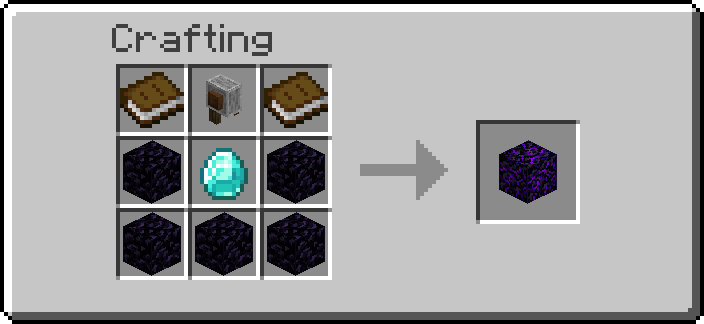
Moves an item's enchantments onto a book.
- Place the Disenchanter (it looks like crying obsidian).
- Put a pipe, tank or Fluid Drain holding experience against one of its sides or under it. A drain facing up takes a sneaking player's experience into the network.
- Drop a book and an enchanted item on top.
Twice a second it checks what lies on it. With both there and the price in the network, it makes an enchanted book holding every enchantment of the item, and the item stays on the block without them. The book stack loses one book.
| Price | 3000 mL of experience (30 points) per enchantment moved, all at once. Server setting disenchanter_xp (0 to 100000; 0 makes it free and needs no network) |
| Curses | Curse of Binding and Curse of Vanishing stay on the item, as at a grindstone. An item with only curses is left alone |
| Repair cost | Reset, as at a grindstone, so the item is cheap to repair again |
| One at a time | One enchanted item per book: a stack of several enchanted items is left alone |
Items it cannot use (anything but a book or one enchanted item) are left where they are and no
longer looked at until someone picks them up. The Goggles show what it is doing (needs a book,
needs liquid experience, disenchanted, …) and the last price. Where the experience comes from:
the first network beside it that holds the whole price; nothing is taken from a network that
holds less.
Book Upgrader
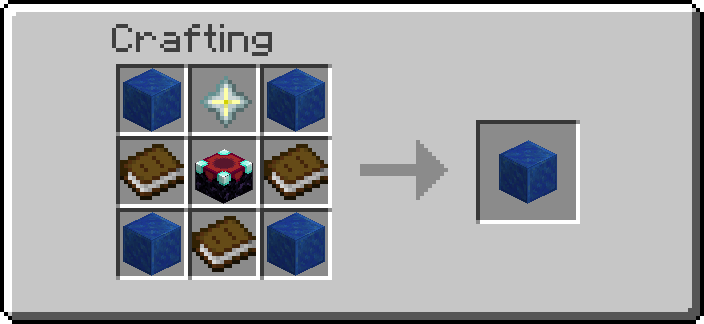
Raises one enchantment of an enchanted book by one level, for a price that doubles every level.
- Place the Book Upgrader (it looks like a lapis block) and put a network holding experience against a side or under it, as for the Disenchanter.
- Drop an enchanted book on top.
Which enchantment it raises:
- the one named by its enchantment property, set with the Data Handler:
sharpnessorminecraft:sharpness. A book without it is left alone; - with the property empty (the default), the first enchantment of the book in alphabetical order of its id that is below the highest level.
| Level | Price (default base 1000 mL) |
|---|---|
| I → II | 2000 mL (20 points) |
| III → IV | 8000 mL (80 points) |
| V → VI | 32000 mL (320 points) |
| IX → X | 512000 mL (5120 points) |
The price is base × 2^level mL, taken all at once; with less than that in the network nothing is
taken and the book waits on the block. The highest level it makes is 10. Server settings:
book_upgrader_base (1 to 1000 mL) and book_upgrader_max (1 to 20).
One level at a time: the raised book stays on the block and is not raised again until someone picks it up and throws it back, so a network is never drained by accident. A book with nothing left to raise (all at the highest level, or without the chosen enchantment) is left alone. The Goggles show the chosen enchantment, what it is doing and the last price.
Book Printer
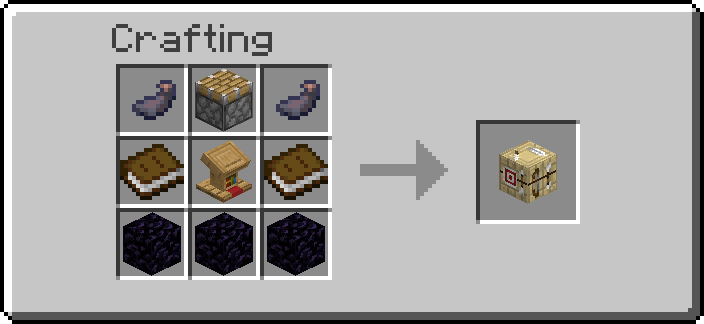
Copies enchanted books. First you gamble a book for its Schematic; then the Schematic prints copies of that book on plain books, for liquid experience.
Drawing a Schematic
- Place the Book Printer (it looks like a fletching table).
- Drop an enchanted book on top.
The book is used up, whatever happens, and rolls once:
| Outcome | Chance | You get |
|---|---|---|
| Hit | 2% (server setting book_printer_chance, 0 to 100) |
A Schematic of the book, on the block, with enchant particles and a level-up chime |
| Miss | the rest | Nothing — the book is gone, with a puff of smoke |
It is a gamble, like the enchanting table: at 2% you spend fifty books on average for one Schematic, so draw from a book worth copying. Drawing costs no experience.
The Schematic is a map-like sheet whose tooltip lists the book's enchantments and levels. It cannot be crafted, and it is not an enchanted book: an anvil, a grindstone or the Disenchanter ignores it.
Setting the Schematic
Right-click the printer while holding a Schematic: one Schematic is taken from your hand and kept in the printer, which now prints that book. If it already held one, that one comes back to you, dropped at your feet. Right-clicking anything else with a Schematic shows a hint.
| To get the Schematic back | |
|---|---|
| Wrench | A plain right-click with the Wrench takes it out, on top of the block |
| Break the printer | It drops with the printer |
A Schematic thrown on the printer is ignored: it only goes in with a right-click.
Printing
- Put a pipe, tank or Fluid Drain holding experience against a side of the printer or under it, as for the Disenchanter.
- Set a Schematic (above), then drop a stack of plain books on top.
Twice a second, while there are books and experience, one book becomes an enchanted book with the Schematic's enchantments. The Schematic stays in the printer: print as many copies as you have books and experience.
| Price | 2500 mL of experience (25 points) per enchantment level of the copy, all at once: Sharpness V costs 12500 mL, Efficiency V + Unbreaking III 20000 mL. Server setting book_printer_xp (0 to 100000; 0 makes it free and needs no network) |
| Not enough | With less than the price in the network nothing is taken, and the book waits |
| No Schematic | Books wait on the block until one is set |
| One thing at a time | An enchanted book lying on the printer is drawn before anything is printed, so do not drop books you want to keep while it prints |
Copies and Schematics come out tagged as done: they are not drawn again or printed on until
someone picks them up and throws them back. The Goggles show what it is doing
(no Schematic: right-click it with one, needs liquid experience, printed,
the book crumbled, Schematic drawn!, …), the last price, and the stored Schematic's
enchantments (or Schematic: none). The Data Handler shows schematic (read-only): whether one is
set.
Advanced
Adding your own recipes
Recipes come from the function tag #ra_enchanting:recipes, so an addon adds its own without
touching this module. A recipe list looks like this:
# /my_addon:enchant_recipes
# An earlier recipe already matched: it wins, leave its result and chance alone.
execute if data storage ra:enchant result run return 0
execute if data storage ra:enchant input{id:"minecraft:stone"} run data modify storage ra:enchant result set value {id:"minecraft:diamond",count:1}
execute if data storage ra:enchant result run data modify storage ra:enchant chance set value 5
execute if data storage ra:enchant result run return 1
| Storage | Meaning |
|---|---|
ra:enchant input |
the sacrificed item, components and all |
ra:enchant result |
the item to produce; leave it unset for "not mine" |
ra:enchant chance |
percent, 1..100, default 5 |
ra:enchant won, ra:enchant lost |
optional plain-text messages for the player who threw the item, on a hit and on a miss |
The messages go to the item's thrower (execute on origin); an item dropped by a hopper, a mob or
a player who has since left tells nobody, and only a thrower with Chat notices on in
Your Preferences reads them. The Overstar and the Master Capture Net use them.
The first recipe that matches wins: every list in the tag runs, so each must start with the
if data … result run return 0 line. In the pack's own Kotlin, sacrificeRecipe(...)
(ra/modules/enchanting/SacrificeRecipe.kt) writes exactly these lines.
The Disenchanter
Settings (Server Settings, Enchant Crafting page): disenchanter_xp and whether the block may be
placed. It is not a network node: like the Boiler, it reads the networks of the fluid nodes on
its four sides and below (ra_enchanting:xp/pay), so it never splits or joins one. It takes from
the first whose network holds the whole price of experience, with ra_lib:transport/net/take.
Only the vanilla curses (minecraft:binding_curse, minecraft:vanishing_curse) stay on the item;
a data pack's own curse moves to the book. Status for the Goggles is in data.status.state and
data.status.price. It has no properties.
The Book Upgrader
Property enchantment (text, may be empty). It is never pasted into a command: it is compared
with the ids of the game's enchantments, a list written into ra_enchanting:blocks/book_upgrader/pick
and only when the pack is built. So an enchantment added by a data pack is never raised. The
level is written by one macro (book_upgrader/apply) whose id comes from that same list. Settings
book_upgrader_base and book_upgrader_max; the cap stops at 20 so the price
(base × 2^19 at most) stays inside 32 bits. The price is one /compute
(mul(base, pow(2, level))), and a price that ever failed to compute would read 0 and be refused.
The Book Printer
One read-only property, schematic (bool: whether one is set). Settings book_printer_chance
(percent, rolled with random value 1..100) and book_printer_xp. A Schematic is
minecraft:paper with custom_data {ra:{schematic:1b,enchantments:{...}}}: the book's
stored_enchantments, copied compound to compound with data modify. They are kept in custom data
rather than in an enchantment component so that no vanilla block (anvil, grindstone) treats the
Schematic as a book. Its lore is written when it is drawn, one translated line per enchantment, by
book_printer/lore, a list of the game's enchantment ids written from Kore at build time; the two
macros (lore_one, lore_add) receive only those ids and the level as an int. A data pack's own
enchantment is printed but shows as + other enchantments.
The Schematic is an endless consumable like the Pattern: a
right-click fires the using_item advancement ra_enchanting:schematic/use, which walks the
player's look (schematic/ray) and runs book_printer/insert as the first Book Printer it enters.
The whole item is kept in data.data.item (count 1) and given back by the wrench
(book_printer/eject) or on break; data.data.summary holds the same lore lines, written at
insert, for the goggles. Printing reads the enchantments from data.data.item. The price is one
/compute, mul(cost, levels), where levels adds up the levels from the same list
(book_printer/levels); a data pack's own enchantment counts as one level. Experience is paid as
for the other blocks (ra_enchanting:xp/pay). Status in data.status.state and
data.status.price.
Cost
The enchanting blocks run every ten ticks from the same scan, and only a block with an untagged
item lying on it does any work: an empty one costs one entity test. Items they cannot use are
tagged ra.ench.done, like sacrifice products.
The table scan looks for item entities every five ticks. Items produced by a sacrifice are tagged
ra.ench.done and skipped from then on, so an upgrade landing back on the table is not
sacrificed again.