Transport Networks
The ra_wires module adds liquid, gas, and EU transport.
- Namespace:
ra_wires - Get the blocks: the Wires Bundle (
/function ra:items/bundles/give_wires_bundle) - Creative-only sources:
/function ra_wires:items/give_creative - Runtime architecture: How It Works
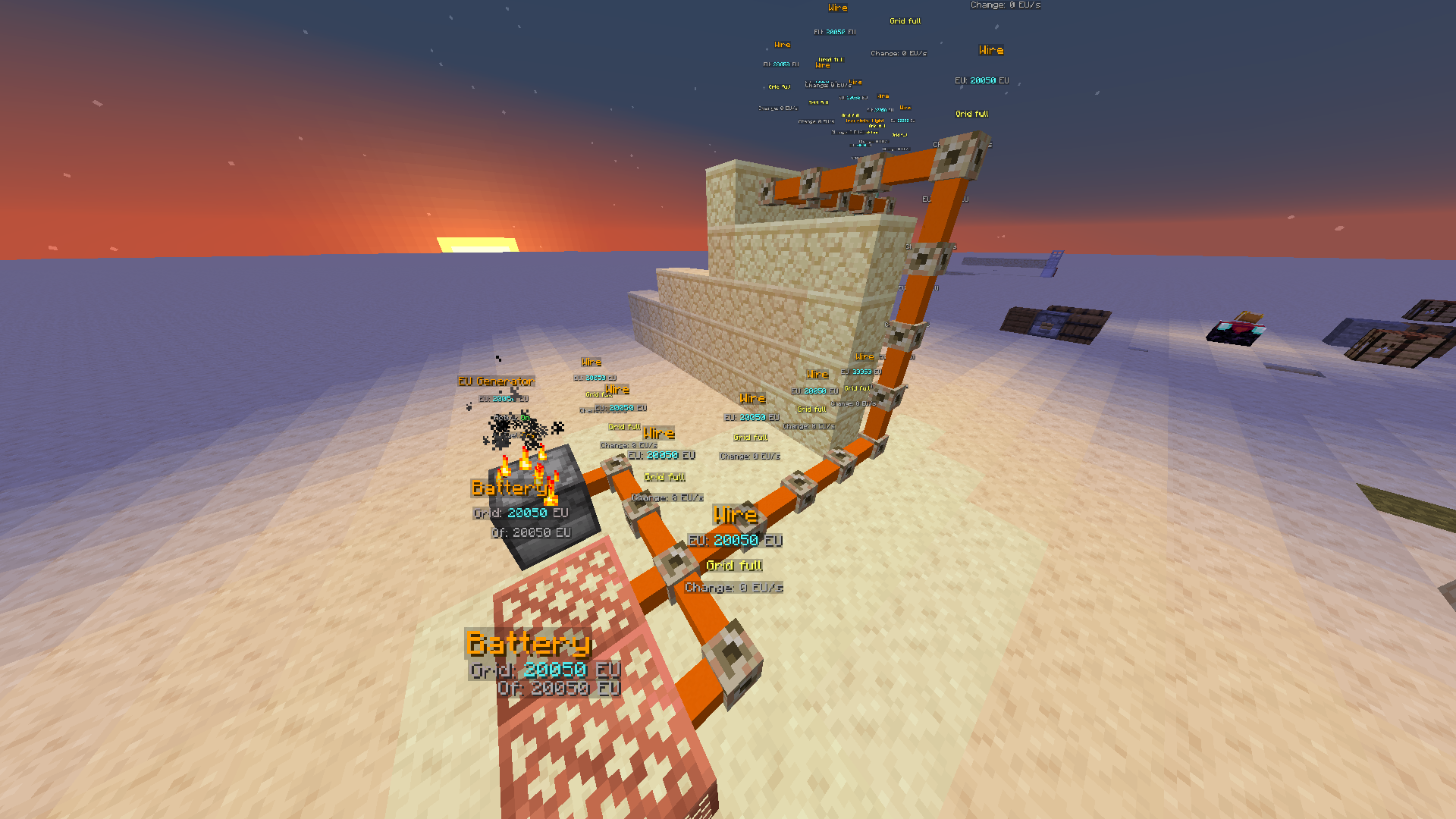
An EU grid: generator, wire, battery and consumers, with the goggles reporting what each one holds and whether the grid is gaining or losing.
Block Families
| Family | Blocks | Notes |
|---|---|---|
| Fluid | Copper Pipe, Liquid Tank, Liquid Pump, Liquid Valve, Liquid Drain | Liquids and gases share one pipe network |
| Gas | Gas Tank, Gas Pump, Gas Valve, Boiler | Gases use the same pipes as liquids |
| Electric | Wire, EU Generator, EU Consumer, EU Switch, EU Breaker, Battery, Solar Panel, Industrial Light, Electric Furnace | Grid-wide EU: batteries store it, breakers bridge grids |
Flow Model
Contents belong to the network, not to individual blocks — fluids and EU alike.
Electric used to be the exception: every wire held its own charge and, once a tick, handed half the difference to one neighbour that had less. That model levels charge out, it does not deliver it. Charge crawled one block per tick, a generator with six neighbours fed exactly one of them, and once a run had evened out to within 1 EU everywhere the transfer guard stopped it moving at all, so a consumer at the end of a line was fed by whatever leaked past the wires in front of it. Electric now runs on the same engine as fluids, and everything below applies to it word for word.
A connected run of pipes, tanks, pumps, valves and drains is one network with one pool of contents and a capacity equal to the sum of its members. Adding a pipe adds capacity; it does not add another buffer that fluid has to be pushed through. That pool can hold several media at once — see Mixing media in one run.
That means:
- Nothing travels. Anything a pump or a generator adds is immediately available to every drain or consumer on the same network, however far away, on the same tick.
- Pipes, tanks, valves, wires and switches do no per-tick work. Only the blocks that move something between the world and the network are ticked — pumps, drains, boilers, generators, solar panels, consumers. A hundred-block run is free to keep running.
- Network membership is recomputed only when a node is placed or broken, and is debounced so laying a long run costs one rebuild rather than one per block.
- A network keeps its number. The id the Multimeter shows is an identity, not a position in a list: extending a run, or tearing out an unrelated one somewhere else in the world, leaves it alone. A run split in two keeps the number on one half and the other half gets a fresh one; a run whose blocks are all broken loses its number for good, and it is never issued again.
It did not used to work that way. Ids were handed out 1, 2, 3… on every
rebuild, so breaking one run slid every higher-numbered run down one. The
Multimeter would say "Network 22", the run would be torn out, and nets.n22
would still be sitting in storage ra:transport afterwards holding a different
run's water — which reads exactly like a network that refused to die.
Network state:
data.properties.*— configuration the player can change (mode,rate,cooldown).data.status.*— read-only values for goggles, redrawn once a second.
Capacity is Storage, and Storage is Finite
A network holds exactly what its members can store, and nothing carries a hidden buffer. Fluids are measured in millilitres; a bucket is 5000 mL.
| Block | Holds |
|---|---|
| Pipe (either tier) | 1000 mL |
| Pump, Drain | 5000 mL |
| Tank, Gas Tank | 100000 mL (20 buckets) |
| Creative Fluid Source | 100000 mL |
| Ender Fluid Vault | 1000 mL |
| Wire, EU Switch, EU Breaker, Ender Power Vault | 0 EU |
| EU Generator, Consumer, Solar Panel, Electric Furnace | 50 EU |
| Battery | 10000 EU |
| Creative EU Source | 100000 EU |
Network totals live in storage ra:transport nets.n<id> rather than on a
scoreboard fake player. A scoreboard gives one number per network, which is
exactly the shape that has to change when a network can hold several media at
once; a compound already has room for the per-medium map. Arithmetic still goes
through scoreboards, because commands have no other way to add two numbers.
Valves and Liquid Filters are bridges, not members: they move contents between two networks and hold nothing themselves, so they add no capacity to either side and never appear in this table.
Wire stores nothing. A grid with no battery on it holds only the small working buffers of its generators and consumers, so whatever is generated has to be spent on the same tick or it is lost — build batteries or waste your output. This is the electric answer to "a pipe adds a litre": a run of wire is not secretly a tank.
A world source block pumps in as 5000 mL. A cauldron gives up its bucket across its three levels, 1667 + 1667 + 1666. The Boiler trades 1000 mL of water for 1000 mL of steam per cycle.
Media
Each medium carries its own colour and particle, so water splashes, lava sparks and experience glows rather than everything emitting the same grey smoke.
Registered: water, lava, powder snow, milk, experience, potion, steam, smoke, oxygen.
One experience point is 100 mL, and the rate is the same in both directions — what a player pours into a drain is exactly what a drain set to place gives back, as orbs.
potion is one medium, whichever potion it is
A network holds several media at once, but every
potion is the same medium — potion — because the variety lives beside the
amount rather than in the media list. The first potion into a network is the
one it keeps; a second, different potion poured in adds to the same
potion entry and arrives as the first one. A Liquid Filter set to potion
passes potions as a group, not one kind of potion.
The Drain's Three Roles
Two are set with the wrench: drain takes a world source into the network, place spends network contents putting a source block back.
The third is decided by how you place the block. Stood vertically it stops working on the world entirely and becomes the loading point, taking filled containers in from three places, tried in that order:
- A sneaking player's main hand. The empty is left in your hand.
- A container on top of the drain. The empty goes back into that container, or is dropped if it no longer fits.
- Loose items on top of the drain. The empty is dropped.
Only the first needs sneaking, because a bucket is also how you pick fluid up — without that gate, walking past with a full bucket would quietly empty it. A bucket you have deliberately put in a barrel or dropped on the block is not ambiguous in that way, and running unattended is the point of those two: a hopper feeding buckets into a barrel over a drain is how a base loads a network with nobody standing there.
One container per cycle, whichever route it came from, so the drain's cooldown
still governs throughput.
With nothing it recognises anywhere, it takes a sneaking player's experience instead: ten points a cycle, 100 mL each, whole points only.
The network is charged before the swap, and only if it can take the whole container. There is no such item as a part-full bucket.
Throughput
The wrench cycles three steps on the two blocks whose whole job is a rate:
| Block | Steps |
|---|---|
| Liquid Drain | 2.5 / 5 / 10 L per second |
| EU Consumer | 20 / 40 / 80 EU per tick |
A consumer takes all or nothing, so the heavy setting simply idles on a grid that cannot cover it — that is how you decide what a base spends its generation on.
Bridges
A bridge belongs to neither of the networks it sits between, and that is what makes it work: a node belongs to exactly one network, so anything that joined would merge the two sides and leave nothing to bridge. The Boiler has always worked this way. A bridge also breaks connectivity by existing — a pipe run with a valve in it is two networks, always.
While powered by redstone, a bridge evens the two networks out: it takes from
whichever side holds more and gives it to whichever holds less, up to its rate
per tick, and stops when they are level.
It has no facing. It looks at all six neighbours, finds the networks touching it, and moves from the fullest to the emptiest. Drop it into a pipe run any way round and it works — there is nothing to get wrong and nothing to line up.
It cannot oscillate: the amount moved is capped at the difference between the two sides, so the most that can happen is that they end up level, and once level neither direction fires.
- Liquid Valve / Gas Valve — the fluid bridge. Carries the medium across, and refuses if the far side holds something different.
- EU Breaker — the same block for grids. Two bases with their own batteries share what they have through one.
- Ender Power Vault — a wireless bridge. It joins its local grid so wires connect to it, contributes no capacity, and moves EU to the vault on its channel — out of the grid at this end and into the grid at the far end. Whatever the far grid cannot accept is put straight back.
The Valve changed meaning
The Valve used to be a shutoff that cut a line by leaving its network. It is now a two-way link between two networks and needs redstone to do anything. An existing build using a valve as a closed tap will find it does not conduct at all until powered. To cut a fluid line now, remove a pipe.
Pipes, tanks and wires carry no configuration at all — they are pure conductors and capacity. The EU Switch is still a true shutoff: it leaves its network when turned off, so the two halves genuinely become separate grids.
Media
Media are named, not numbered:
| Key | Name | State | World block |
|---|---|---|---|
water |
Water | liquid | minecraft:water |
lava |
Lava | liquid | minecraft:lava |
powder_snow |
Powder Snow | liquid | minecraft:powder_snow |
milk |
Milk | liquid | — |
steam |
Steam | gas | — |
smoke |
Smoke | gas | — |
oxygen |
Oxygen | gas | — |
A network holds any number of these at once and clogs on the sum — see Mixing media in one run. A medium drained to nothing leaves the network entirely, so a run that once carried lava stops claiming to, and a network drained to empty forgets everything.
Pumps and Drains
Liquid Pump — pulls a world fluid source into the network. It checks all six adjacent blocks, so it works whichever way you place it. A source block is all-or-nothing: the pump only takes it if the whole 5000 mL fits, so a nearly full network cannot delete a lake a partial bucket at a time. Cauldrons go in thirds — 1667, 1667, 1666 mL — because a third of 5000 does not divide.
Liquid Drain has two modes, cycled from the wrench menu:
drain— takes a world source into the network (like a pump, on a slower cycle).place— spends 5000 mL putting a source block of the network's primary medium back into the world, on the first free side. Below 5000 mL it saysnot_enoughrather than placing a partial block.
place mode is what makes a network worth building: carry lava from a pool to
wherever you want it, or refill cauldrons across a base.
Infinite Sources
A body of nine or more matching source blocks within two blocks of the one being taken counts as inexhaustible, and the block is left alone. Anything smaller is genuinely consumed, so small pools empty out.
Boiler and the EU Chain
The Boiler sits between two networks — it is deliberately not a member of either. A node belongs to exactly one network, so a Boiler that joined would put its water side and its steam side into the same one. A network can hold both now, but that is precisely what you do not want here: the two would share one pool of volume, the steam would be drawn back through the Boiler's own inlet, and the EU Generator on the far side would be reading a run that is half water. Keeping it outside is what makes the chain directional.
water network → [Boiler over a heat source] → steam network → [EU Generator] → EU
- Any block in
#ra_wires:heat_sourcesunder the Boiler will do: lava, fire, soul fire, magma block, campfire, soul campfire, lava cauldron. - Consumes 1000 mL of water and produces 1000 mL of steam per cycle, once every 20 ticks.
- The EU Generator burns steam, or solid fuel dropped straight into it — it is a barrel wearing a furnace skin, so loading it is just putting coal in a box. Either way it does not generate power from nothing.
- The Solar Panel generates EU from sky light instead, scaling with the vanilla daylight detector's own light reading — so night, rain, roofs and snow cover all reduce it automatically. It offers what it makes every tick, 10 EU/t at the dimmest light it registers up to 50 EU/t in full noon sun, which is a shade under one EU Generator. It stores nothing overnight by itself: a panel contributes 50 EU of capacity, so a solar base wants Batteries.
Mixing media in one run
A network holds several media at once. Water, lava and steam can share a pipe run, each with its own entry, and the run clogs only when the sum of everything in it reaches the capacity — not when any one medium does. A pipe run is one pool of volume that several media share, and you budget it as one number.
This is what changed: a network used to refuse any medium that was not the one it already held, so a run was single-purpose for as long as it held anything at all, and switching it over meant draining it first. Nothing refuses an offer now except a lack of room.
The primary medium is whichever arrived first and has not run out. It is what a Valve or a Breaker moves when nobody told it otherwise, and what a Drain places when nobody named a medium. A medium drained to nothing leaves the network entirely, so a run that once carried lava stops claiming to.
Networks saved by an earlier version migrate the first time they are read. They cannot be enumerated by id from a function, so there is no sweep on load — the whole amount moves into the key of whatever medium the network was recorded as holding, and nothing is lost.
Reading a mixed run
The Goggles name a single-medium run — Medium: Water — and say
Medium: Multimedium for anything holding two or more, over the usual Amount:
line for the total. They do not list the breakdown: a billboard is one short line
read from across the room, and Water 5000 mL, Lava 5000 mL, Steam 2000 mL is
neither short nor legible at that distance.
The Multimeter is where the breakdown lives, because chat has room for a line per medium:
── Copper Pipe ──
  Network 22   this block adds 1000
  Stored 10000 of 20000
  Holding
    Water  5000 mL
    Lava  5000 mL
A run holding one medium keeps it on a single line — Holding Water 5000 mL.
The media are listed in the order they arrived, so the first line is the primary.
EU grids read the same way, in EU.
Liquid Filter
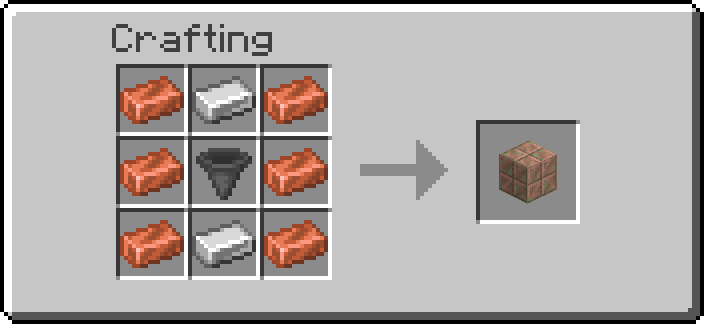
A Valve that passes only one medium. It is what turns a mixed run back into single-medium runs: put one on each branch, set each to a different medium, and a pipe carrying water and lava together sorts itself into two.
| Property | Default | Meaning |
|---|---|---|
filter_medium |
water |
The only medium it will pass |
rate |
2000 |
Millilitres per tick, the block's own |
Set filter_medium by shift+RMB with the Data Handler
and using [Modify] on that row. It takes a medium name — water, lava,
steam, potion and the rest of the Media table — not an item id.
Like every bridge it belongs to neither network, breaks connectivity by existing, needs redstone to run, and finds its two sides itself whichever way round it was placed. It levels per medium: two runs each holding 5000 mL are not level to a water filter if one of them is all lava.
The Goggles name the medium it is set to in that medium's own colour, and say so in red if the name is not one the pack knows — a filter set to a misspelt medium would otherwise look identical to one working correctly and passing nothing.
Potions keep their effects
A potion emptied into a Drain is 1000 mL of the potion medium, and the network
remembers which potion. A Drain set to output pours it over everyone within
four blocks rather than placing it as a block, because a potion has no block.
The duration follows the volume: the potion's own duration is what a full bottle gives, and a partial draw is a proportional share of it. 250 mL of a three-minute Strength potion is forty-five seconds. The level is the potion's own and is not scaled — half a bottle of Strength II is still Strength II, for less time.
Preset potions get their effects from a table in ra_wires:media/potions, because
a preset potion carries only its id and nothing that says Strength lasts three
minutes. A potion brewed with commands carries custom_effects on the item and is
read straight off it.
The first potion in wins. A network already holding one potion keeps that identity when a different one is poured in. The alternatives were refusing the second pour — the single-medium behaviour this release removes — or averaging two effect lists, which means nothing.
Valves
A valve genuinely splits the network in two. The halves then hold separate contents and separate media. Closing a valve is the supported way to isolate part of a system.
The state is set with redstone; either way the network follows.
Visual Connectivity
Each node draws only its own half of a connection — from its core out to its block boundary, never across into the neighbour. Displays are rebuilt only when a conduit appears or disappears at a marker, never on a tick where nothing changed.
Fluid pipes render as a chunky 0.56 core in copper or iron. Electric wires are deliberately thinner (0.26) and use concrete, so the two are easy to tell apart at a glance.
Goggles and Tinkering
Goggles show medium, amount, and per-block state lines.
Tinkering — sneak and hold goggles in the main hand near a node:
- Most nodes: nothing to cycle — the wrench says so.
- Drain: cycle mode between
drainandplace.
Pumps have nothing to configure; they take whatever they find next to them.
Extending New Media
- Add an entry to the registry in
ra_wires:media/init— display name, state, colour, particle, and optionally a world block and bucket. - If it can be pumped out of the world, add a
source_blocksentry naming the block state, the medium, the volume, and what the block becomes when drained.
That is all. Nothing else needs a per-medium branch.
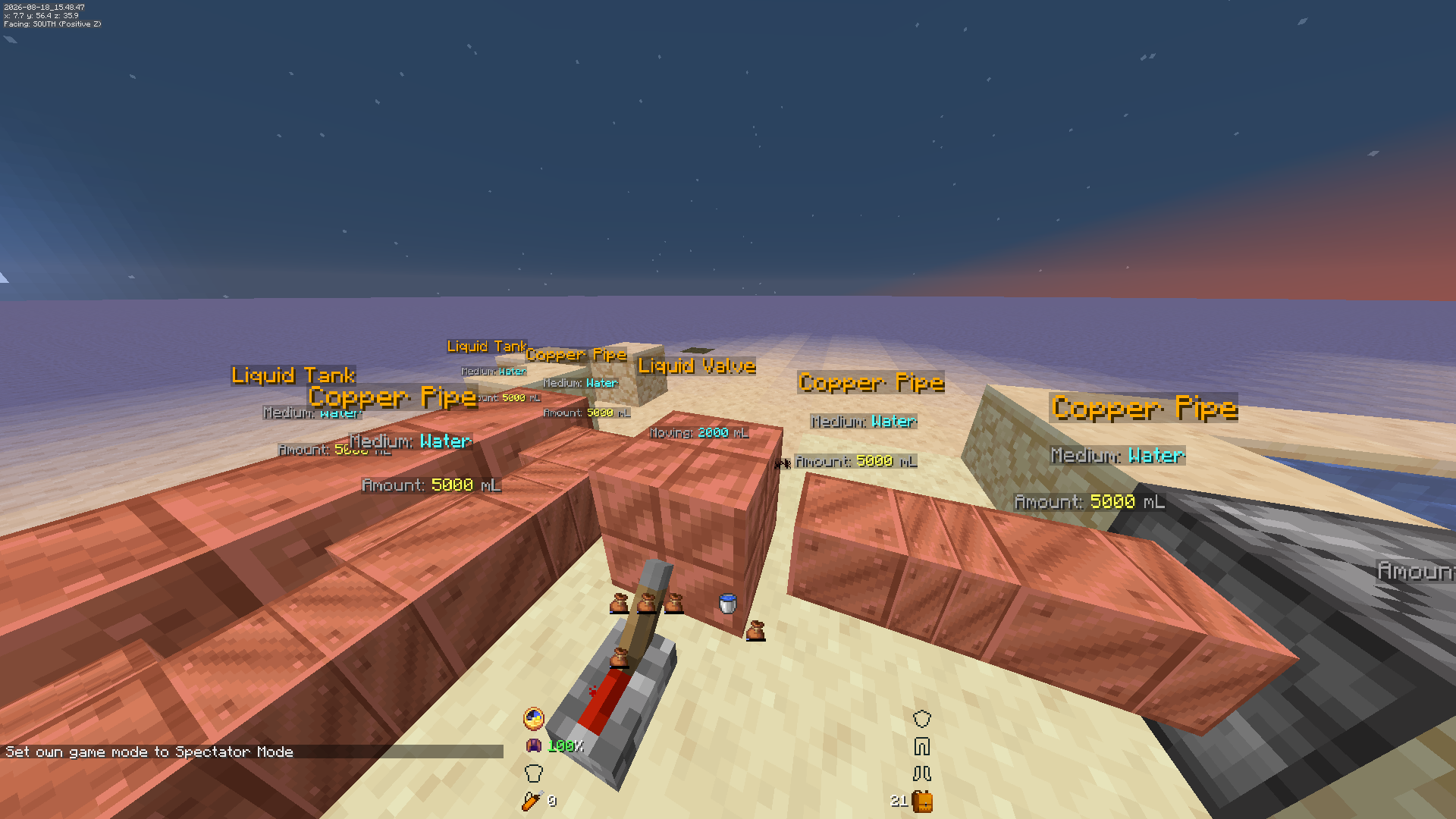
A fluid network in millilitres. Contents live on the network, not in the pipes — a pipe only adds capacity.
Electric Furnace
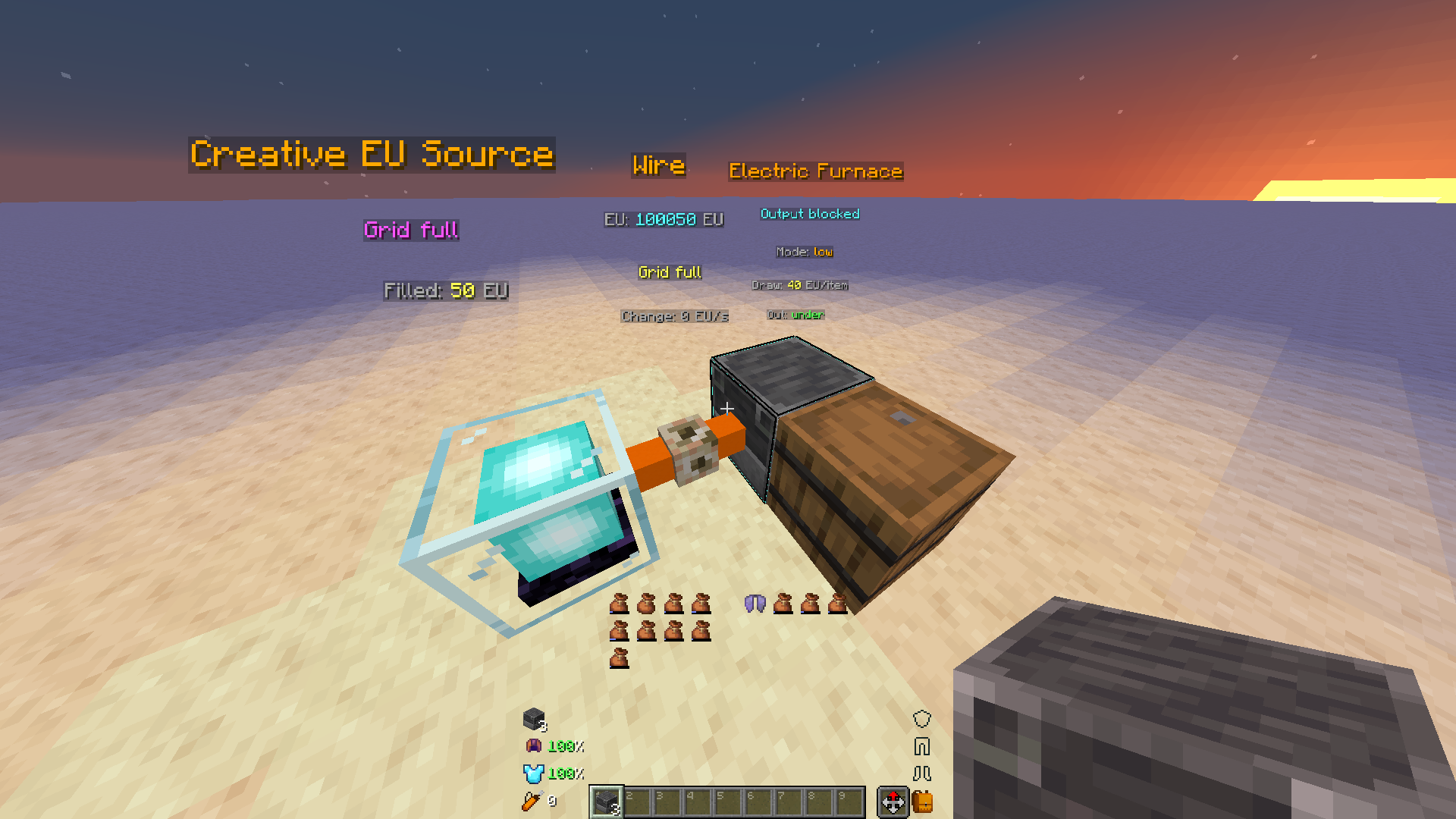
Smelts using EU instead of fuel. There is no fuel slot, because there is no fuel.
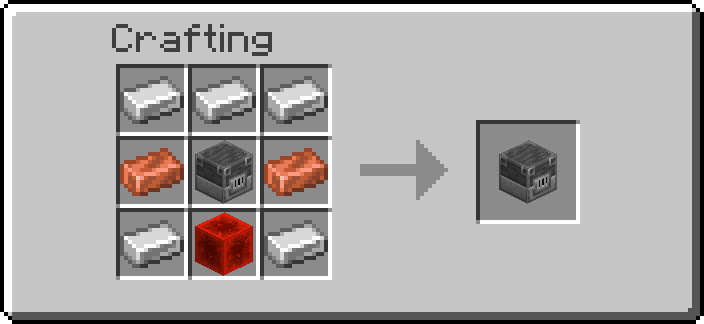
| Mode | Ticks per item | EU per item | EU per tick |
|---|---|---|---|
| low | 100 | 40 | 0.4 |
| medium | 50 | 80 | 1.6 |
| high | 20 | 160 | 8 |
| superpowered | 5 | 300 | 60 |
Cycle the mode with the wrench. EU per item rises faster than speed does on purpose: four times quicker for four times the power would leave no reason to run anything but superpowered, and "low" would never be a real choice on a small grid.
The scale is anchored on the generators the pack ships. One EU Generator makes 60 EU/t, so superpowered is one generator running flat out. A Solar Panel peaks at 50 EU/t, so it is a couple of panels at noon, or a handful plus a Battery to carry the night. Low is still 7.5x cheaper per item than superpowered, which is what keeps it worth using for bulk smelting.
How input and output are split
Input is the furnace's own barrel — any smeltable stack, any slot.
Output is pushed into the container on one chosen face: under, front, back or top, chosen from the wrench menu. The power mode is in the wrench menu as well — shift+RMB lists Output, Power and Enabled together.
Results never come back into the furnace. That is what stops it smelting its own output — cobblestone would otherwise become stone and then smooth stone — and it means there is no slot rule for anyone to remember. Feed it with a hopper from any side; take from the destination container with anything at all.
If the destination is missing or full the furnace stops and the goggles read
Output blocked. That is checked before any EU is spent and before the input
is consumed, so a blocked output costs nothing and destroys nothing.
What it can smelt
The recipe table is hand-maintained (ra_wires:blocks/electric_furnace/init_recipes),
because a data pack cannot ask the game what a vanilla smelting recipe produces.
It covers ores and raw metals, iron and gold gear back to nuggets, food, sand,
clay, stone, cracked bricks and logs to charcoal. Anything not in the table is
left alone.
Industrial Light
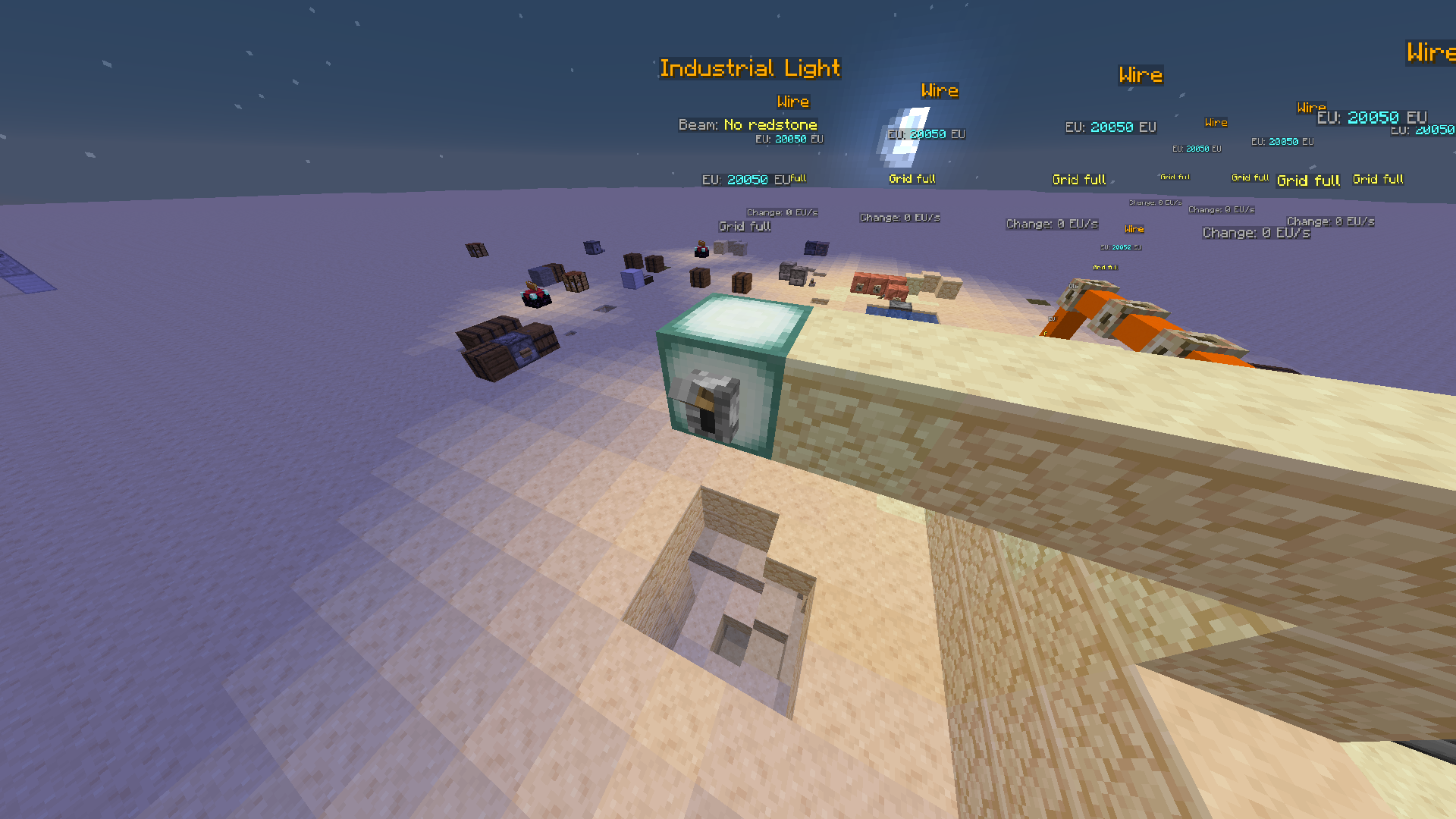
Redstone and EU, projecting a ten-block beam of real minecraft:light. It
stops at the first solid block, and the only block it will ever remove is a light
of the exact level it places.
| Unpowered | Lit |
|---|---|
 |
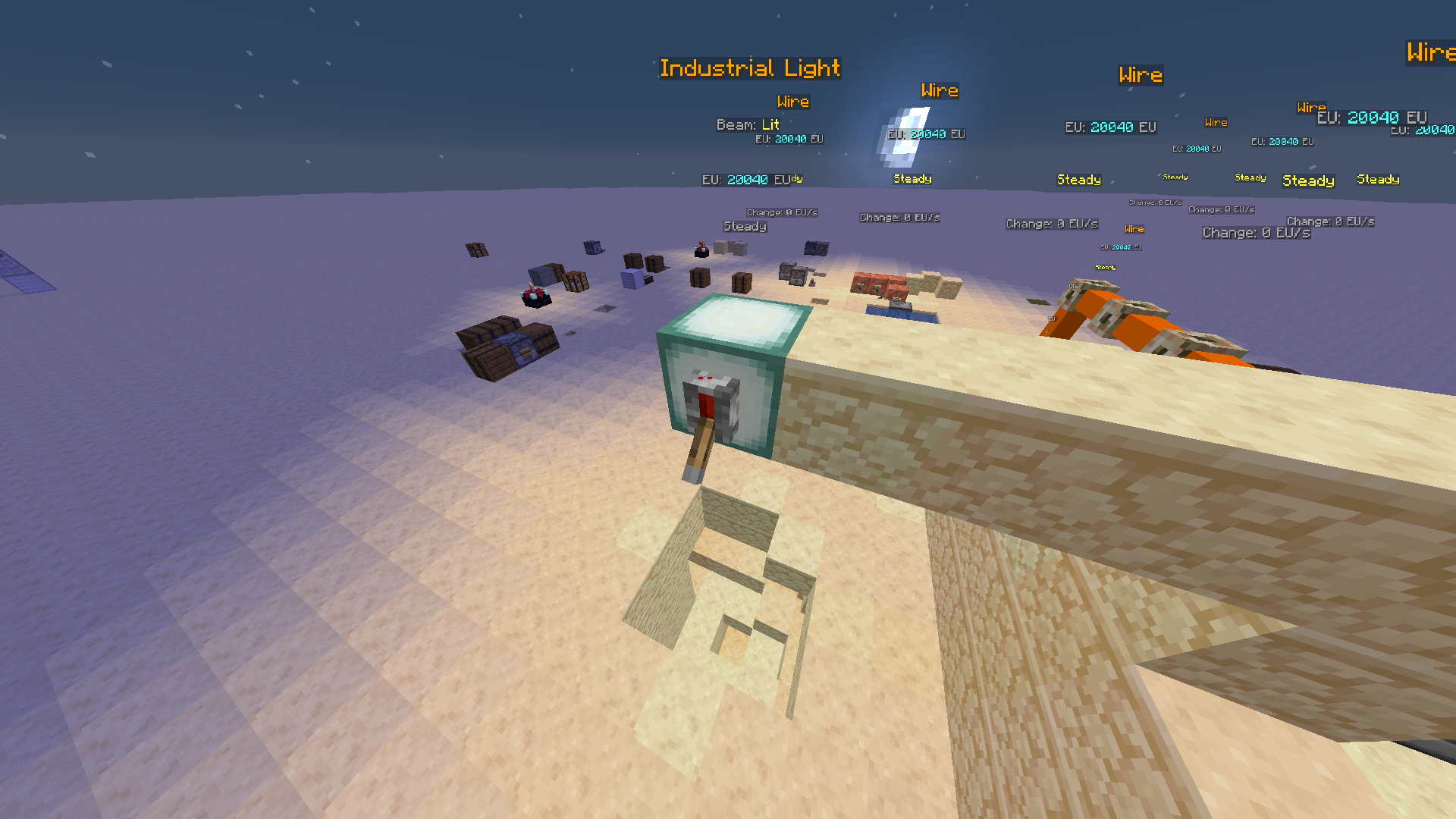 |
The goggles name whichever condition is missing — No redstone or No EU —
rather than a bare "Dark".
Creative sources
Two blocks that make something from nothing, for building and testing the
consuming half of a system without also running a fuel farm or a pump farm to
feed it. Neither has a recipe. Both are in the Wires Bundle with the rest of the
module, or /function ra_wires:items/give_creative for just the two.
| Block | Real block | What it does |
|---|---|---|
| Creative EU Source | minecraft:beacon |
Refills its grid to capacity every tick |
| Creative Fluid Source | minecraft:beacon |
Tops its network up with one medium, at rate per tick |
The EU source fills to capacity rather than producing a fixed rate, so it does not matter how much the grid draws: whatever was spent last tick is back this tick and a machine on a creative grid never sees a brownout.
The fluid source's medium is a property rather than a fixed choice, so one source
can be used to test a water line and then a lava line. Cycle it with the wrench,
which can only land on a medium that exists, or type it on the medium row of
the Data Handler — free text is checked against the media registry first, because
a junk key in a network is one nothing could ever drain.
Why the fluid source has a rate and the EU source does not
The fluid source adds rate mL per tick, 1000 by default, and stops when the
network is full. The EU source has no rate because a grid is emptied every tick
by whatever is drawing on it; a pipe run is not.
Filling a run to the brim in one tick is what a single-medium source wanted, and it is exactly wrong now that a run can hold several media. A source offering the whole of the free space took the entire network on the tick it was placed, and every other source, Pump and Drain feeding that run then found a full network for ever. A mixed run could not be built anywhere a Creative Fluid Source was attached, and the failure looked like the run refusing the new medium rather than like the source having already claimed it.
With a rate, sources sharing a run interleave and the run ends up holding all of
them. Set rate high on the Data Handler for a single-medium test rig where
instant refill is what you want.
A full network still refuses everything, correctly — mixing needs headroom. If you are building a mixed run to try it out, leave the creative source off it and fill from Drains, or give the run more tanks than one source will fill.